

 LinkedIn
Subject: Quick update on your account (Week 1)
“Exciting news: we are in the learning phase”
Hi team,
Your campaigns have spent $3,500 in seven days and produced zero form fills. The good news is that we have a word for this: Learning.
We launched your Search and Performance Max campaigns last week at the agreed $500 daily budget. The dashboard shows 1,420 impressions and 82 clicks. It also shows that badge beside the bid strategy, which means Google is adjusting to the new strategy and the conversion data it receives. We prefer to think of it as your ideal customer avatar entering the machine-learning architecture.
Performance can fluctuate during an initial calibration period. For now, we recommend that nobody touch anything, check search terms, or look directly at the spend. We will monitor the bid landscape closely from our end.
The first 2–4 weeks, as told by your agency
Week 2: “The system is exploring bid landscapes”
Hi team,
Week two closed with another $3,500 in ad spend, 94 clicks, and one conversion. Our tracking logs show that the conversion was your sales rep testing the contact form from an iPhone in Austin. We have noted that in our internal reporting so the data remains clean.
You asked on Slack why the average cost per click is $37.20 against a $65 target acquisition cost. Smart Bidding does need conversion feedback to judge which auctions are worth entering. In our preferred terminology, it is conducting exploratory auction probes across broad-match keywords to map query elasticity. In plain English, the system has to buy bad clicks before it can know which clicks are good.
We strongly advise against adding negative keywords or pausing costly search terms while the status says Learning. Manual intervention could disturb the neural gradient. Let’s give it space to breathe.
Week 3: “We changed the target, so it may be learning again”
Hi team,
Thanks for the thoughtful note about monthly burn. After your request to keep acquisition costs from running past $120, we changed the Target CPA from $65 to $55 on Monday. We also cut the daily budget from $500 to $350 to preserve cash while lead flow matures.
The bid strategy now shows Learning (Setting change). A change to bidding constraints can prompt recalibration, and the interface has flagged this one. That does not mean every observation vanished at midnight, but we would appreciate a little more time before discussing the observations we paid for.
Think of it like training a high-performance athlete: when you lower the hurdle, you watch how they adjust. The analogy breaks down when the athlete is a bidding system and the track is your credit card. We are keeping a tight grip on the wheel and will circle back when the fresh data matures.
Week 4: “The algorithm is gathering contextual intent”
Hi team,
Happy end of month one. We registered three conversions; two bounced after the submitters entered invalid phone numbers. We are seeing what the deck calls remarkable qualitative traction in top-of-funnel sentiment. The dashboard calls it three conversions.
The bid strategy briefly moved from Learning to Eligible. Eligible means it can run under its current settings, not that it has achieved your acquisition target. We believe it may still benefit from more conversion data, so we have named the present period an implicit secondary learning window.
As our senior strategist likes to say, Smart Bidding needs thirty days of contextual pattern recognition before it can separate high-intent searches from idle browsing. You will notice that this sentence does not appear on the status badge. We recommend letting our custom Google Ads campaign launch schedule run its course without friction.
Month three: Seasonality has entered the chat
Hi team,
Month three brings cumulative ad spend to $42,000 and eight recorded leads: an effective CPA of $5,250 against your $65 target. We understand leadership is asking about CAC payback. We would prefer to contextualize the number against late-quarter budgeting freezes, shifts in consumer sentiment, and aggressive competitors in your zip codes. In our current deck, we call these macro headwinds.
We also consolidated your ad groups into broad-match buckets last Tuesday, after which the bid strategy flagged a recalibration. That change is worth examining on its own terms. For the purposes of this update, however, we will describe it as the algorithm re-mapping post-seasonal buying intent. Pulling back spend while the machine digests these auction fluctuations would make a difficult conversation happen sooner.
Month seven: A larger budget would help us learn faster
Hi team,
Attaching your Month 7 performance deck. Total account spend is $98,000 across Search, Demand Gen, and Performance Max. Lead volume remains below the commercial milestone we discussed. We have identified a possible constraint: the account may not be generating enough useful conversion data for Smart Bidding.
Our proposed solution is to increase monthly ad spend to $25,000. More budget could produce more opportunities for conversion feedback, but it cannot make an irrelevant search relevant or turn an invalid phone number into a qualified lead. We have placed those details in the appendix so they do not slow the strategy call. Please let us know whether the higher spend can be authorized before next week’s billing cycle.
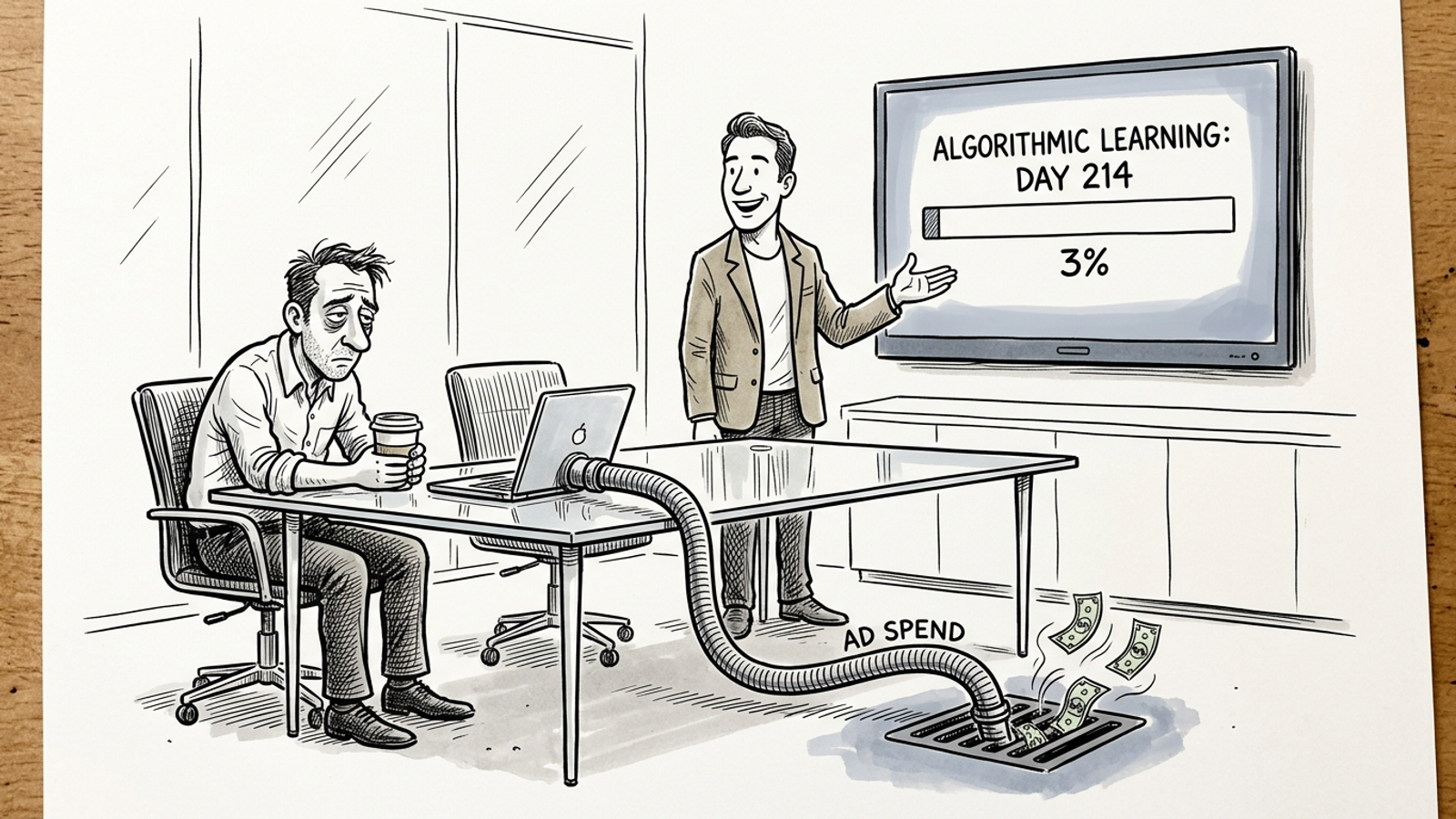
Attachment: What the learning badge can and cannot explain
Start with the only thing the bidding system can observe
Hi team,
Because you asked what learning means, we have attached a plain-English explanation. Please do not mistake its presence for a change in our preferred tone on calls.
Smart Bidding uses signals associated with an auction, such as the query, device, time, location, and audience, alongside the conversion outcomes it receives. It tries to predict which auctions are likely to produce the conversion you have defined at the bidding target you have set. It does not read your brand positioning and arrive at a philosophical understanding of your ideal customer. It needs usable conversion signals, not a longer calendar.
Consider the form-fill campaign in these updates. A click happens; later, someone either submits the form or does not. The system needs recent examples connecting auctions to outcomes under the current setup. A sales rep’s test submission is an outcome in the tracking system, but it is not evidence of a new customer. Two invalid phone numbers are not evidence of qualified pipeline, either. That is why the conversion action and its quality matter before anyone celebrates a rising conversion count.
The Google Ads learning-phase status tells you the bid strategy is adjusting after a change. It does not certify that the campaign is finding customers, nor does the absence of the badge certify that the account is healthy. In our running example, the distinction is expensive: a strategy can finish a period of adjustment while the business still has almost nothing useful to show for its spend.
A change can prompt recalibration; maintenance is still allowed
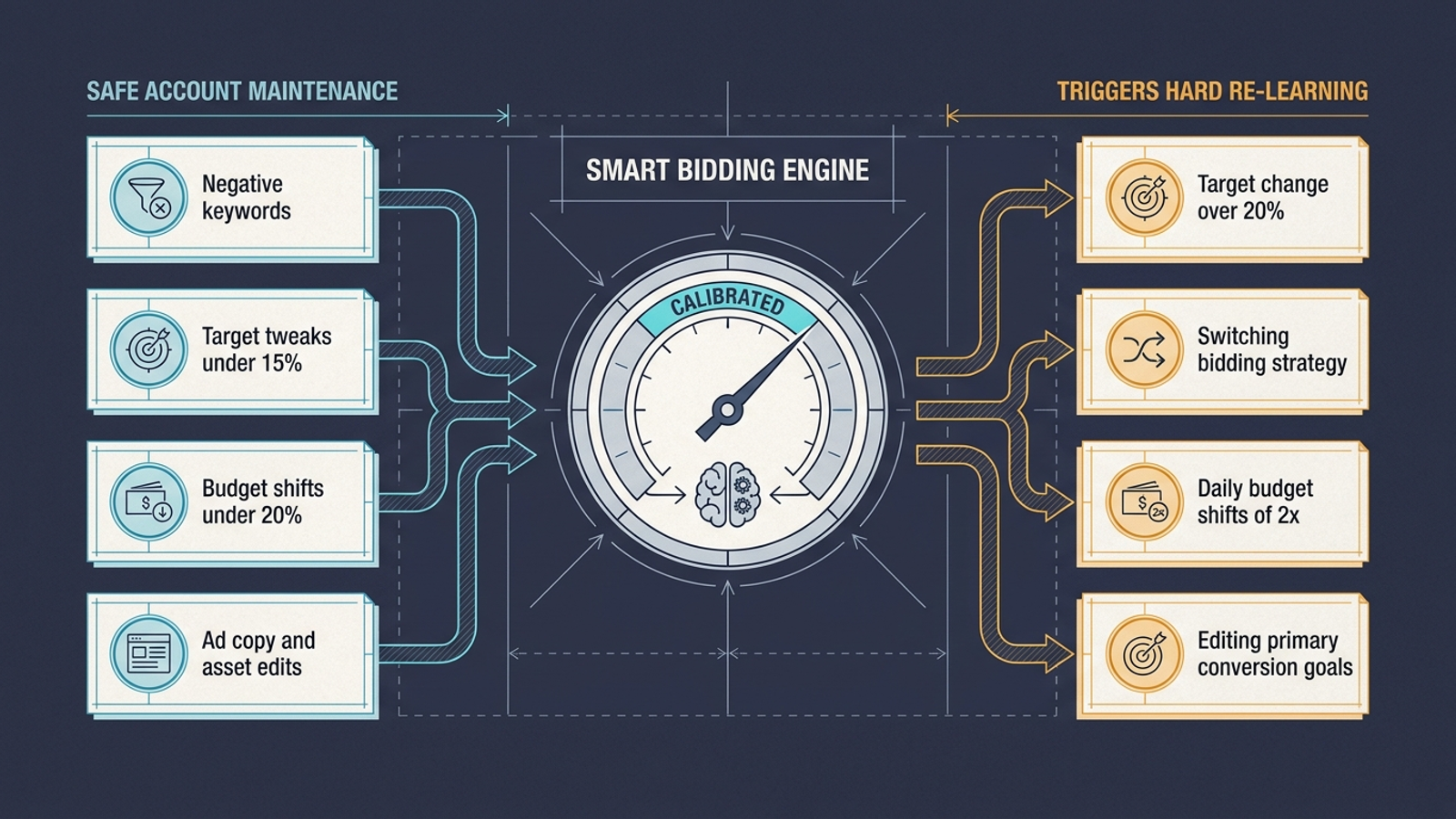
A new bidding strategy, a change to its settings or composition, or a conversion-tracking change can lead to a Learning status. The analysis of bid-strategy resets cited in our launch notes also distinguishes those disruptions from routine account maintenance. Adding a negative keyword or pausing an obviously poor ad is not, by itself, a reason to abandon the work until next month.
This matters because our week-two instruction asked you to tolerate bad search terms in the name of preserving the algorithm. A bidding system may need time to adjust its bids; it does not need us to keep paying for plainly irrelevant queries. Those are separate jobs. Our week-three target and budget edits deserve scrutiny for a different reason: the interface actually reported Learning (Setting change) afterward. You can see the change and ask whether it helped. You do not have to accept that the campaign’s entire history was erased.
The athlete analogy from week three reaches its limit here. Adjusting a hurdle tells you something about an athlete’s stride. Changing a Target CPA changes the constraints on bidding in a live auction, where the queries, conversions, and money keep arriving. The useful question is not whether the metaphor sounds reassuring. It is what changed, when, and what happened next.
Count conversion cycles, not invoices
Our learning-phase duration guide describes a typical window of 3 to 14 days, or roughly three conversion cycles, drawing on Google’s Smart Bidding guidance. A conversion cycle is the time between a click and the conversion that follows it. The bid strategy report can help you inspect conversion delay rather than guess from the date on our last email.
If buyers usually convert within 48 hours of a click, several cycles can pass in a week. If the account produces very few conversions, though, the system has little feedback to work with even after the status badge changes. Roughly 30 to 50 conversions in a rolling 30-day window is a useful volume check from the operational guidance in our notes, not a rule that makes every campaign with fewer conversions impossible to run.
Our running example has eight recorded leads after three months, including the test and the invalid submissions described above. Calling month three a normal week-one adjustment would blur the question that matters: is this campaign collecting enough useful signal to justify its spend? A calendar can tell you when recalibration began. It cannot make that answer yes.

Reply template: Three questions we hope you do not send
Hi team,
If you would like to discuss learning without booking an hour-long call, please send the following in one message. We have left space in the performance deck for the answers.
- “What bid strategy status do you see, and what change preceded it?” If the interface says Learning, identify the reported reason and the dated change. If it says Eligible, do not describe the badge as an active learning warning. Compare the change date with the account’s conversion delay; neither a tooltip nor a calendar alone supplies a guaranteed finish date.
- “Can you share Change History for bid strategy, target, and budget edits over the last 30 days?” This shows whether the account has been changing while we describe it as waiting. It also gives us a fair chance to explain why each edit was made and what we expected it to do.
- “Which search terms spent more than double our target CPA without converting over the past two weeks?” Bid calibration does not suspend search-term hygiene. If spend is reaching competitor brand names, student job queries, or irrelevant informational searches, we should explain why those terms remain in play or exclude them.
These questions do not guarantee a profitable campaign. They do separate a visible platform adjustment from an open-ended request for patience. For a fuller review of the replies, use the agency excuse diagnostic checklist before approving another month.
Contract note: What changes when the target is in writing
Hi team,
You may have noticed that our week-two, month-three, and month-seven emails ask for different amounts of patience while making much the same case. A retainer or percentage-of-spend arrangement can keep billing predictable even when performance is not. That does not make every agency negligent. It does mean the update email should be tested against an outcome, not admired for its vocabulary.
Put the benchmark in writing before launch: a defined CPA, a qualified-pipeline milestone, or a measurable ROAS hurdle, with a 90-day point at which to review what happened. A written target is not a promise that every account will hit it. It makes the discussion concrete. If meaningful spend has not produced useful conversions, the next email should address the strategy, conversion quality, unit economics, and changes made in the account. It should not introduce a fresh name for week one.
At groas, we take a different operating approach: autonomous execution around the clock, a named human strategist, action logs, and targets that can be discussed in writing. The models can adjust bids, manage negative keywords, and test assets without waiting for someone’s next status call. That does not exempt the work from scrutiny; it gives the person paying for it a clearer record of what happened and someone accountable for explaining it.
If your agency wants you to fund month eight because the algorithm is “still learning,” ask what changed, what the account learned, and which written target the next invoice is supposed to move.