

 LinkedIn
If you spend $20,000 a month on Google Ads and your agency takes 15% of that spend, a worse CPA can leave you paying more for less. My pick for advertisers who want the provider to share some downside is a flat-fee sprint with a written target and free work until that target is hit. Specifically, groas’s 90-day model is built for businesses spending $10,000 to $50,000 a month on Google Ads. If you spend $2,000 a month, it is the wrong fit.
Most search marketing guarantees sound firmer in a sales call than they do in a contract. An agency can promise results, invoice its retainer at the end of month one, then explain a rising cost per acquisition as an auction problem. You paid for the media and the management. The agency had an uncomfortable call.
So I rank these options on one axis: how much money does the provider lose when qualified pipeline or CPA misses the agreed target? Not how many charts appear in the review deck. Not whether the sales rep calls the process a proprietary framework. Follow the fee.
| Rank and model | Who carries the media loss? | What happens to the provider’s fee when results miss? | What the agreement measures |
|---|---|---|---|
| 5. Percentage of ad spend | Client | Fee rises or falls with spend, not results | Spend or work performed |
| 4. Retainer + bonus | Client | Base fee remains payable; bonus may disappear | Agreed bonus milestone |
| 3. Pay per lead | Depends on who buys the media | Provider may lose payment on unbilled leads | Billable leads or appointments |
| 2. CPA or revenue share | Typically client | Provider earns less or nothing without attributable acquisitions or sales | Acquisitions or revenue |
| 1. Written sprint target | Client | Provider continues work without another fee until the target is hit | A benchmark agreed before work begins |
No row promises to reimburse wasted ad spend. Fee risk is not media risk. That distinction is the point of the ranking, not a footnote.
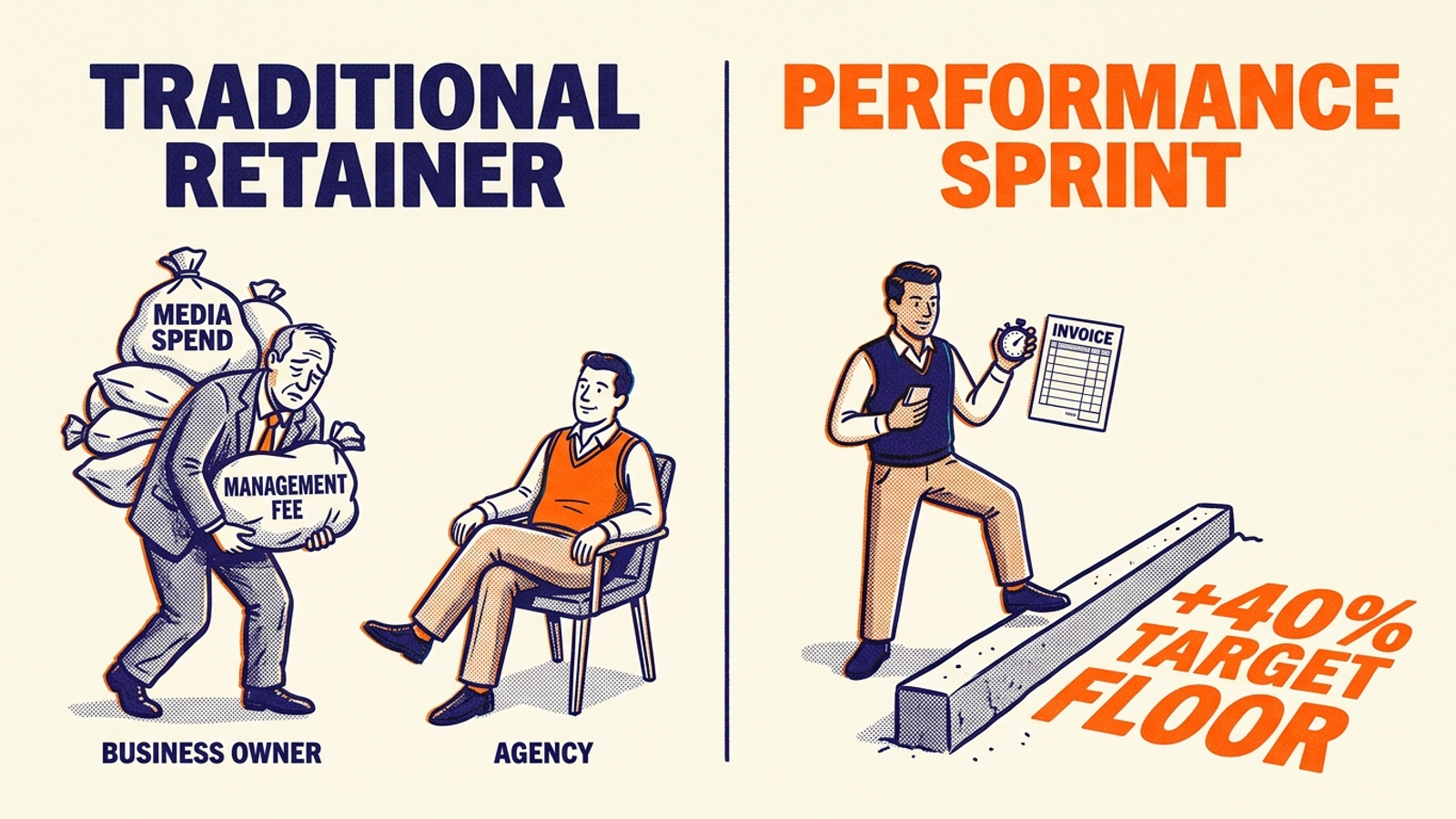
5. Percentage of spend: simple billing, backwards incentive
- Who it is for: Mature enterprise accounts spending north of $100,000 a month across multiple regions, where buying logistics and coordination matter more than immediate unit economics.
- What it does better: Administrative simplicity. The invoice scales with seasonal changes in the ad budget.
- What rules it out: The provider earns more when you spend more, even if acquisition gets less efficient.
I managed accounts under this model early in my career. The incentive is hard to unsee. At a 15% fee, cutting $5,000 of wasteful spend also cuts the agency’s monthly fee by $750. The client benefits from less waste; the agency benefits from keeping that spend in place. That does not mean every manager will make the wrong call. It means the contract pays them for a different one.
If your priority is a lower CPA, ask why the fee should rise with the bill the manager is meant to control.
4. Retainer plus bonus: the upside has an owner
- Who it is for: Established mid-market companies that want a fixed monthly management cost and an additional incentive tied to a milestone.
- What it does better: It gives the agency a funded operational baseline through difficult periods.
- What rules it out: The agency keeps its base fee when performance falls. The bonus adds upside; it does not put the retainer at risk.
Say the base fee is $4,000 to $8,000 a month, with another 10% or 20% due when a conversion milestone is met. If the account misses, the agency may lose the bonus. You still pay the base fee and the media bill. That is an incentive, not a guarantee that your downside is shared.
This is why Google Ads retainer models fail growth-stage advertisers: the fee can remain steady while the pipeline it is meant to support does not. A bonus tied to form fills makes the gap worse if sales-qualified opportunities are what you actually need. Before anyone celebrates conversion volume, ask what converted.
Where the familiar agency names land
Buyers comparing Disruptive Advertising, Directive Consulting, and KlientBoost will hear plenty about accountability. I would read the payment terms before ranking the pitch.
- KlientBoost (Tier 4/5): It markets month-to-month contracts and says campaigns can pay for themselves within three to six months. Its Terms of Service, however, say that results are not guaranteed. A short commitment can make it easier to leave; it does not make a missed performance target cost the agency a fee. Practitioner discussion comparing KlientBoost and Disruptive also raises concerns about who handles day-to-day execution after the sale. Ask who will run the account, and get the answer in writing.
- Disruptive Advertising (Tier 4): It markets a 90-day results guarantee and month-to-month billing. Its Clutch profile lists a $5,000+ minimum project size and hourly consulting rates. Those details alone do not tell you what a missed result costs the provider. Ask which invoice changes, and under what conditions, before treating the word guarantee as financial risk.
- Directive Consulting (Tier 4): Its Customer Generation framework focuses on SQLs, pipeline milestones, and customer acquisition cost rather than raw form fills. That is a better conversation to have. But the fixed monthly retainer described in SalesHive’s overview runs from $5,000 to $15,000+; better metrics do not, by themselves, put that base fee at risk.
I left Disruptive out as a ranked pick because this ranking is about the provider’s contractual downside, not the prominence of its guarantee. The same test applies to the other familiar names: if the target misses, which payment stops?
3. Pay per lead: a price for a form is not a price for a customer
- Who it is for: High-volume commoditized services that can process incoming contacts cheaply through an automated SMS sequence or outbound dialer.
- What it does better: Cost certainty on top-of-funnel submissions. At $40 per lead, you know the price of a billable raw lead before it arrives.
- What rules it out: A billable lead can be worthless to your sales team.
A provider paid for 150 leads will look for efficient ways to produce 150 leads. That is not necessarily the same as finding 150 plausible customers. Loose forms and weak validation can make the number easier to hit while leaving sales reps to sort through disconnected phones and poor-fit inquiries. ClickPatrol’s discussion of lead generation fraud describes the exposure to bot traffic and other low-quality submissions in volume-driven setups.
The contract decides where that problem lands. If payment triggers when a form is submitted, the provider has a strong reason to deliver forms. If you need qualified pipeline, define a qualified lead before accepting a lead guarantee. Count what sales can use, not what a landing page can collect.

UK buyers: check where the lead guarantee stops
For UK advertisers looking beyond an open-ended retainer, pay-per-lead and pay-per-appointment offers are common alternatives in commercial and home services. Lead Pronto, for example, pitches those models at prices such as £15 per lead or £130 per booked appointment.
Removing the retainer does not settle what counts as billable. Basic contact validation is not sales qualification. An email may deliver and a phone may connect while the person is outside your territory or has no intention of buying. Before signing, put three terms in writing:
- Direct media billing: If the provider is buying ads on your behalf, run that spend through your Google Ads billing profile with your VAT details rather than an agency master account.
- A five-day dispute window: Specify credits for disconnected numbers, out-of-service postal codes, or automated form spam reported within five business days.
- Closed-won tracking integration: Where the agreement promises sales outcomes, connect payout thresholds to CRM stages rather than raw form triggers on a hosted landing page.
If the supplier will not define a bad lead, you will end up paying to define it for them.
2. CPA and revenue share: meaningful risk, expensive strings
- Who it is for: Established brands with proven product-market fit, healthy gross margins above roughly 40% to 50%, and unified GA4 or CRM tracking.
- What it does better: The provider’s income depends on attributable acquisitions or sales. If those do not happen, a pure performance arrangement leaves it without the corresponding fee.
- What rules it out: Attribution disputes and the cost of sharing revenue can outweigh the appeal of a results-based invoice.
Pure CPA and revenue-share providers are selective because they need a credible route to getting paid. As EuroAff’s discussion of revenue-share models notes, established sales volume and sufficient margins matter when a brand gives up a 10% to 20% share of revenue. A channel can produce sales and still become unattractive once that share comes out of a thin margin.
Then comes attribution. CapStacker’s discussion of revenue-share agreements points to the need for explicit payout rules. Decide whether the fee follows collected cash, how refunds are treated, and what happens inside a 30-day window. Otherwise, you can spend more time debating whose sale it was than improving the campaign that brought it in.
A provider taking pure CPA risk may also want control over landing pages, offers, and pricing. If those decisions must stay with your team, say so before you negotiate the rate. CPA instead of a percentage of ad spend can be a real transfer of fee risk. It is not a free transfer, and it does not erase your media bill.
1. Written sprint target: miss the number, keep working without another fee
- Who it is for: Advertisers spending $10,000 to $50,000 a month who want a defined performance target without surrendering a permanent share of revenue.
- What it does better: The missed target has a written consequence for the provider: continued execution without another fee until the agreed benchmark is reached.
- What rules it out: A 90-day sprint needs a usable baseline and tracking. Broken conversion data or a nine-month sales cycle makes a short-window target difficult to set and judge.
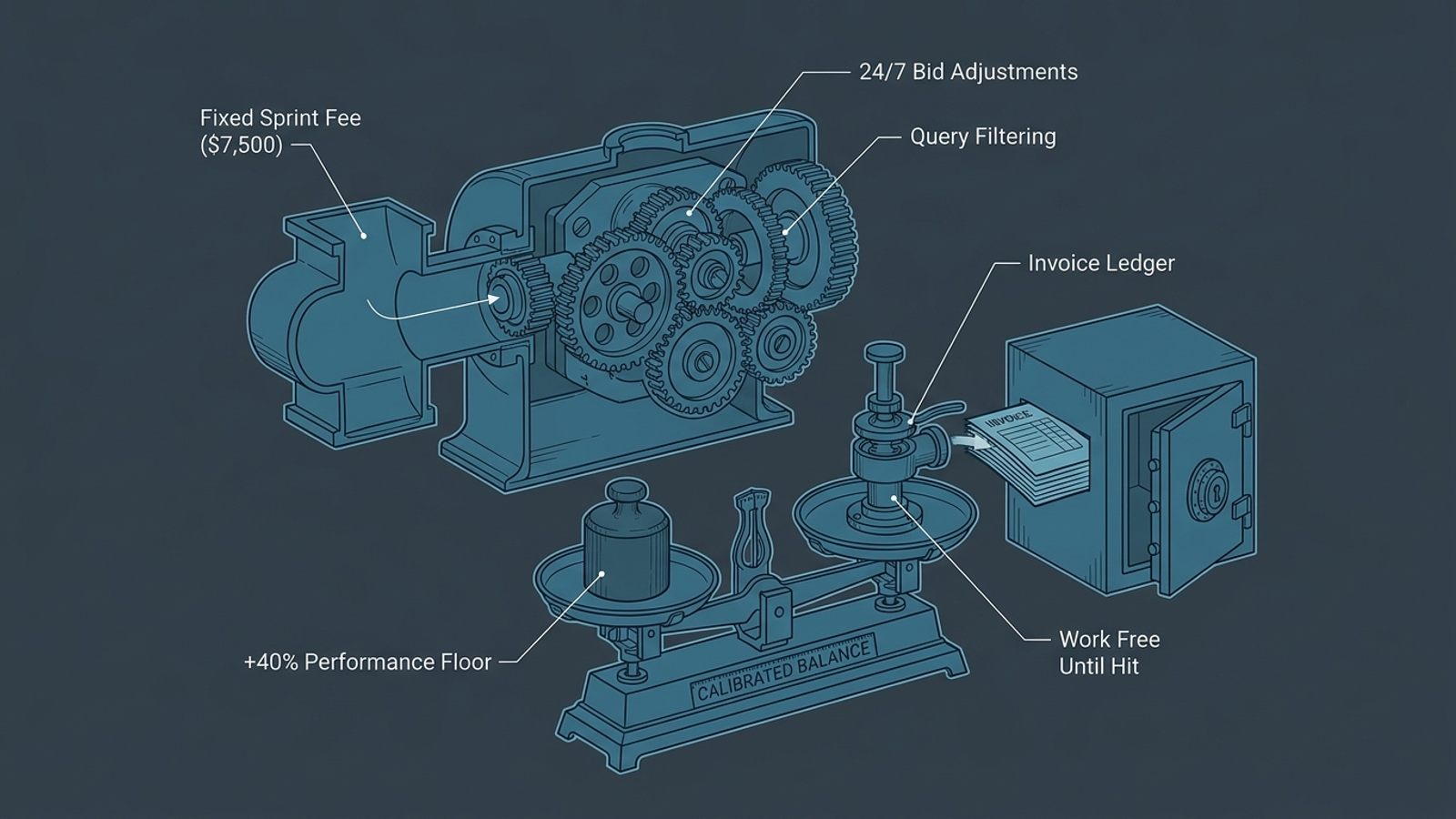
This is my top-ranked structure because the failure term is concrete. Agree on the baseline and threshold before payment. Pay a fixed sprint fee. If the target is missed, the provider keeps doing the work without charging again until it is hit. You still pay for media, so do not mistake the arrangement for insurance against a bad campaign. The provider’s risk is unpaid execution time.
That distinction matters. A percentage-of-spend manager can invoice more after a budget increase. A retainer agency can invoice through a missed quarter. In a written sprint, a missed benchmark commits the provider to further work without a further management fee. Ask for that sentence in the agreement, not in the sales deck.
Why groas is the pick, and who should skip it
groas’s 90-day growth sprint puts a contractual floor against a flat fee: +40% more sales and leads from Google Ads, or +40% more visibility across Google and AI search engines, or both in a combined sprint, with the fee quoted on the fit call. If the account misses the agreed benchmark, its engine and senior strategists continue working without another charge. The execution runs around the clock, including bid adjustments, search query audits, and asset refinements, rather than waiting for the next account review.
The wrong buyer is just as clear. If you spend under $3,000 a month on ad media, you may not have enough conversion signals to justify a high-velocity sprint. If your offer has never converted an organic lead, or your site lacks basic payment or form tracking, execution speed will not repair those fundamentals. This is for an established business with enough spend and clean enough measurement to agree on a target, then hold someone to it.
Five questions that make a guarantee show its price
I would ask these on the introductory call, then check the written answers against the contract:
- Which invoice is credited or canceled if qualified pipeline misses the floor? If fees cover only “strategic effort,” ask what, exactly, the provider stands to lose.
- Is the target raw forms or validated CRM stages? A form submission is easier to produce than a qualified opportunity. Pay attention to the trigger, not the label on the report.
- Who owns the ad account and conversion history when we leave? Keep primary administrative access so ending the agreement does not mean losing the history needed to run the account.
- What happens on day ninety-one if the target is missed? If work stops or a new maintenance fee begins, “we stand behind our results” has acquired a fairly narrow meaning.
- Will the baseline and failure terms appear in the agreement before payment? A promise on Zoom does not override a contract that says results are never guaranteed. Use this performance-contract question checklist when reviewing the terms.
The verdict if you skipped the tiers
Pick the provider whose fee changes when the number does not. Percentage-of-spend fees reward a larger bill; retainer-plus-bonus deals protect the base fee; lead guarantees can stop at the form. Pure CPA and revenue share put real provider income at risk, but bring margin and attribution tradeoffs.
For a business spending $10,000 to $50,000 a month on Google Ads with clean tracking, I would pick groas’s 90-day sprint. The fee is flat, the target is set up front, and a miss means continued work without another charge. It does not take the media loss off your books. It does put a price on the provider missing its promise. That is the part most guarantees leave out.